What Is Marketing Attribution and Why It’s Getting Harder
What Is Marketing Attribution?
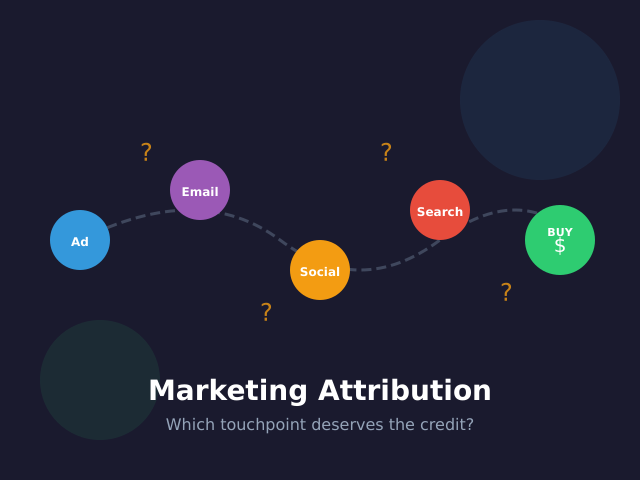
Marketing attribution is the process of identifying which marketing channels and touchpoints contribute to a conversion. When someone buys your product, attribution answers the question: “Which marketing efforts made this happen?”
The concept seems straightforward. However, in practice, attribution has become one of the most challenging problems in marketing. The customer journey is rarely linear, privacy regulations are tightening, and the technical infrastructure that once made tracking easy is disappearing.
In other words, we’re flying increasingly blind — and it’s getting worse.
Why Attribution Matters
Without attribution, you’re guessing where to spend your marketing budget. Consider this scenario:
A customer sees your Facebook ad, clicks a Google search result a week later, receives an email, and finally converts through a retargeting ad. Which channel deserves credit? Where should you invest more?
Attribution attempts to answer these questions. Consequently, it affects critical decisions:
- Budget allocation — Which channels get more funding?
- Campaign optimization — Which ads and creatives work best?
- ROI measurement — Is your marketing actually profitable?
- Strategy direction — Should you focus on awareness or conversion?
Get attribution wrong, and you’ll optimize for the wrong things. As the IAB’s attribution guidelines emphasize, you might kill campaigns that actually work while pouring money into channels that only appear effective.
Attribution Models Explained
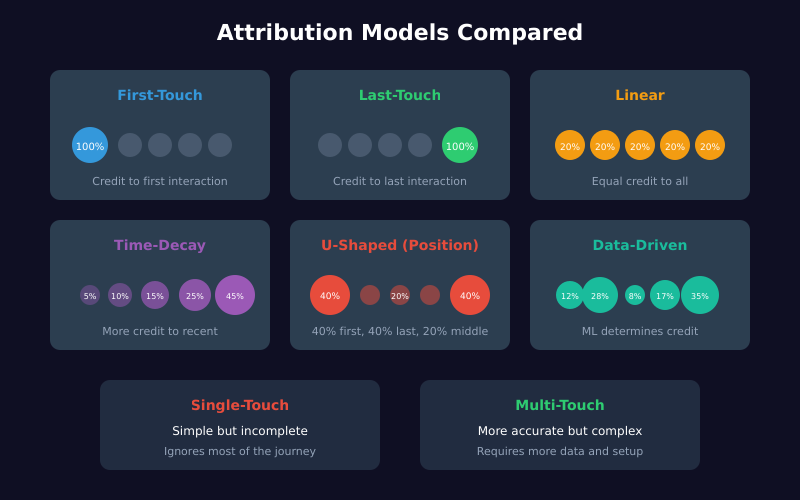
Attribution models are rules for assigning credit to touchpoints. There are two main categories: single-touch and multi-touch.
Single-Touch Attribution
Single-touch models give all the credit to one touchpoint. They’re simple but flawed.
First-Touch Attribution
Gives 100% credit to the first interaction. The ad that introduced someone to your brand gets all the credit, regardless of what happened afterward.
Best for: Understanding which channels drive awareness
Problem: Ignores everything that happened between discovery and purchase
Last-Touch Attribution
Gives 100% credit to the final interaction before conversion. The touchpoint that sealed the deal gets all the credit.
Best for: Identifying what triggers the final decision
Problem: Ignores all the nurturing that made the conversion possible
Both models are still widely used because they’re easy to implement. However, they paint an incomplete picture. In reality, multiple touchpoints influence the buying decision.
Multi-Touch Attribution (MTA)
Multi-touch models distribute credit across multiple touchpoints. They’re more accurate but more complex.
Linear Attribution
Distributes credit equally across all touchpoints. If someone interacted with five channels before converting, each gets 20%.
Problem: Assumes all touchpoints are equally important, which is rarely true.
Time-Decay Attribution
Gives more credit to touchpoints closer to the conversion. The logic: recent interactions had more influence on the decision.
Problem: May undervalue awareness channels that started the journey.
Position-Based (U-Shaped) Attribution
Gives 40% credit to the first touch, 40% to the last touch, and distributes the remaining 20% among middle touchpoints.
Problem: The 40/40/20 split is arbitrary. Why not 30/30/40?
Data-Driven Attribution
Uses machine learning to analyze conversion paths and assign credit based on actual impact. Google Analytics 4 and many enterprise tools offer this model.
Problem: Requires significant data volume to work properly. Also, it’s a black box — you can’t easily explain why it assigned credit a certain way.
Why Attribution Is Getting Harder
Marketing attribution was never perfect, but recent changes have made it significantly more difficult. Here’s what happened.
iOS 14 and App Tracking Transparency
In 2021, Apple introduced App Tracking Transparency (ATT), requiring apps to ask permission before tracking users across other apps and websites.
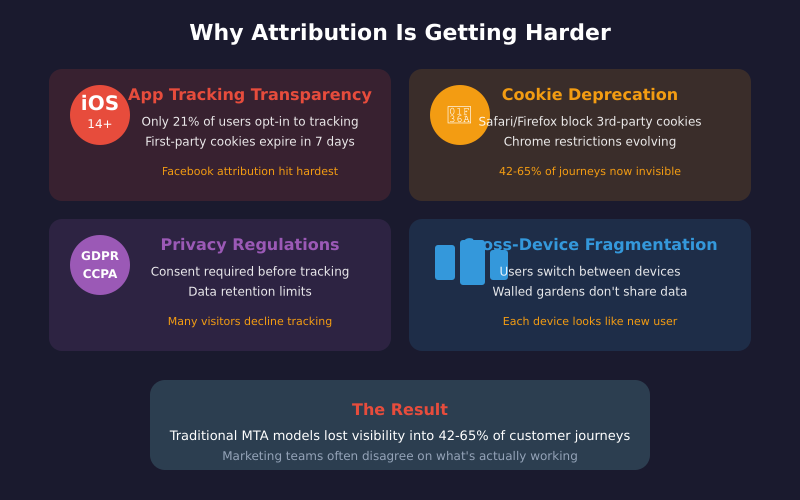
The result? Only about 21% of users opt in globally. For the other 79%, you can’t track their journey across apps.
This hit Facebook advertising particularly hard. Before ATT, Facebook could track users across the web and attribute conversions accurately. After ATT, Facebook lost visibility into a massive portion of iOS user journeys.
Moreover, Apple limited first-party cookies to seven days on iOS. Even if someone visits your website directly, their cookie expires after a week. If they return on day eight, they look like a new visitor.
Third-Party Cookie Deprecation
Third-party cookies enabled cross-site tracking — the ability to follow users as they moved between websites. This was the foundation of most attribution systems.
Google originally planned to eliminate third-party cookies in Chrome by 2025. After multiple delays and industry pushback, they’ve backed off somewhat. However, Safari and Firefox already block third-party cookies by default, and privacy-conscious users increasingly block them manually.
As a result, traditional attribution models that relied on cookie-based tracking have lost visibility into 42-65% of customer journeys, depending on the industry.
Privacy Regulations
GDPR in Europe and CCPA in California (plus similar laws spreading globally) require consent before tracking users. Many visitors decline, creating gaps in your data.
Furthermore, these regulations limit how long you can store data and what you can do with it. Even if you collect the data, you may not be able to use it for attribution the way you once did.
Cross-Device and Cross-Platform Fragmentation
The average consumer uses multiple devices. They might discover you on their phone, research on their laptop, and purchase on a tablet.
Without third-party cookies or persistent identifiers, connecting these touchpoints is increasingly difficult. Each device looks like a separate person.
Similarly, walled gardens like Google, Meta, and Amazon don’t share data with each other. You can see performance within each platform, but connecting the dots across platforms requires probabilistic modeling or self-reported data.
The Attribution Gap
Research suggests that organizations using different attribution models see contradictory results. In companies without clear attribution governance, departments use an average of 3.4 different models, each telling a different story about what’s working.
This creates real problems:
- Marketing says Facebook is driving conversions
- Finance says the numbers don’t add up
- Sales says their leads from Google are better
- Everyone has data to support their position
The result is organizational paralysis. When nobody agrees on what’s working, making confident decisions becomes impossible.
What Actually Works Now
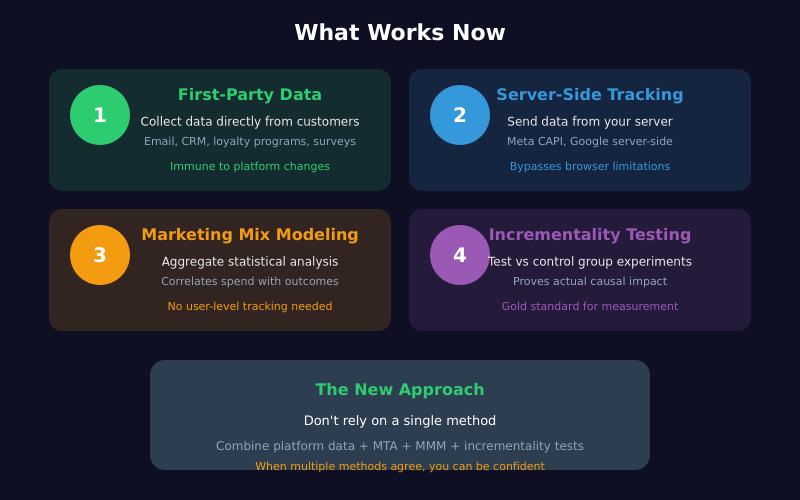
Despite the challenges, attribution isn’t dead. It’s evolving. Here are approaches that work in the current environment.
First-Party Data Strategy
First-party data — information you collect directly from customers — is immune to most privacy restrictions. This includes:
- Email addresses and CRM data
- Website behavior (with consent)
- Purchase history
- Loyalty program data
- Survey responses
Building robust first-party data collection gives you a foundation that doesn’t depend on third-party tracking. However, this requires offering real value in exchange for data sharing. Research shows that clear value exchanges increase consent rates by 3.2x compared to standard cookie banners.
Server-Side Tracking
Instead of relying on browser-based cookies and pixels, server-side tracking sends data directly from your server to advertising platforms.
For example, Meta’s Conversions API (CAPI) lets you send conversion data from your server to Facebook, bypassing browser limitations. Google offers similar server-side solutions.
This approach is more technically complex but more reliable than client-side tracking alone.
Marketing Mix Modeling (MMM)
Marketing Mix Modeling takes a completely different approach. Instead of tracking individual users, it uses statistical analysis to correlate marketing spending with business outcomes at an aggregate level.
MMM asks: “When we increased Facebook spend by 20%, did revenue increase proportionally?” It doesn’t need user-level tracking data.
The downside? MMM requires significant historical data and can’t provide real-time optimization. It’s better for strategic planning than tactical campaign management.
Incrementality Testing
Incrementality testing measures the true causal impact of marketing by comparing groups who saw your marketing versus groups who didn’t.
For example, you might run a Facebook campaign in some geographic regions while holding out others as a control group. Then compare conversion rates between groups.
This approach actually proves causation rather than just correlation. However, it requires running experiments, which means accepting some short-term inefficiency. This is similar to how A/B testing validates assumptions through controlled experiments.
Probabilistic Attribution
When deterministic tracking fails, probabilistic modeling fills the gaps. These systems use signals like IP addresses, device types, browser fingerprints, and behavioral patterns to make educated guesses about user identity.
Probabilistic attribution isn’t as accurate as deterministic tracking, but it’s better than nothing. Most modern attribution platforms combine both approaches.
Practical Recommendations
Given the current landscape, here’s how to approach attribution:
1. Accept Imperfection
No attribution model will give you perfect data. Instead of searching for the “right” model, focus on consistency. Pick a model, understand its biases, and use it consistently over time.
Trends and relative comparisons are more reliable than absolute numbers.
2. Use Multiple Measurement Approaches
Don’t rely on a single attribution method. Combine:
- Platform-reported data (with skepticism)
- Multi-touch attribution for directional insights
- Marketing Mix Modeling for strategic planning
- Incrementality tests for validating assumptions
When multiple methods point in the same direction, you can be more confident in your conclusions.
3. Invest in First-Party Data
This is no longer optional. Build systems to collect, organize, and activate first-party data. This might mean:
- Improving email capture rates
- Building a loyalty program
- Creating logged-in experiences
- Asking customers directly how they found you
Self-reported attribution (“How did you hear about us?”) is imperfect but increasingly valuable when tracking fails.
4. Implement Server-Side Tracking
If you’re spending significant money on digital advertising, server-side tracking is worth the investment. It won’t solve everything, but it recovers some of the data lost to browser restrictions.
5. Align Your Organization
Attribution conflicts often stem from organizational misalignment rather than technical problems. Establish:
- A single source of truth for marketing data
- Agreement on which models to use and when
- Clear ownership of attribution methodology
- Regular calibration between marketing and finance
When Attribution Isn’t Worth the Effort
Sometimes, sophisticated attribution is overkill. Consider simpler approaches if:
- You’re a small business — The complexity of multi-touch attribution may not be worth it if you only use a few channels
- Your purchase cycle is short — If customers convert immediately, last-touch attribution might be sufficient
- You have limited data — Data-driven models need volume to work properly
In these cases, focus on basic tracking, customer surveys, and common sense rather than complex attribution systems. Understanding your conversion rate benchmarks often provides more actionable insight than perfect attribution.
The Future of Attribution
Attribution isn’t going away, but it is changing fundamentally. The future likely involves:
- AI-powered probabilistic modeling — Machine learning filling gaps in deterministic data
- Privacy-preserving measurement — Techniques like differential privacy that provide insights without exposing individual data
- Aggregated reporting — Platforms providing cohort-level rather than user-level data
- First-party data ecosystems — Companies building their own data infrastructure
The era of tracking every user across every touchpoint is ending. What replaces it will be less precise but potentially more privacy-respecting.
The Bottom Line
Marketing attribution was never perfect, and it’s getting harder. Privacy changes, cookie deprecation, and platform fragmentation have created significant blind spots in our ability to track customer journeys.
However, this doesn’t mean you should abandon measurement. Instead, adapt your approach: invest in first-party data, implement server-side tracking, use multiple measurement methods, and accept that some uncertainty is unavoidable.
Ultimately, the goal isn’t perfect attribution. It’s making better marketing decisions than you would without measurement. Even imperfect data, used consistently and thoughtfully, beats flying completely blind.
The marketers who thrive in this new environment will be those who embrace uncertainty while still demanding rigor — accepting that “directionally correct” is often the best we can achieve.