AI search SEO is what happens when ChatGPT, Perplexity, Claude, and Google’s AI Overviews start handling 30%+ of the queries that used to go into Google’s blue-link search box. The ranking signals still matter, but what counts as a win changes. A top-3 blue-link ranking is worth less when the user never scrolls past the AI-generated answer, and being cited inside that answer is a different optimization problem than getting the classic rank.
In this guide, I’ll explain how AI search actually works, what changes for SEO strategy, and which tactics I’ve seen produce real citation visibility in AI responses. I’ve been tracking this shift across multiple sites since late 2024, and the patterns are clearer now than the hot takes suggest.
What Is AI Search?
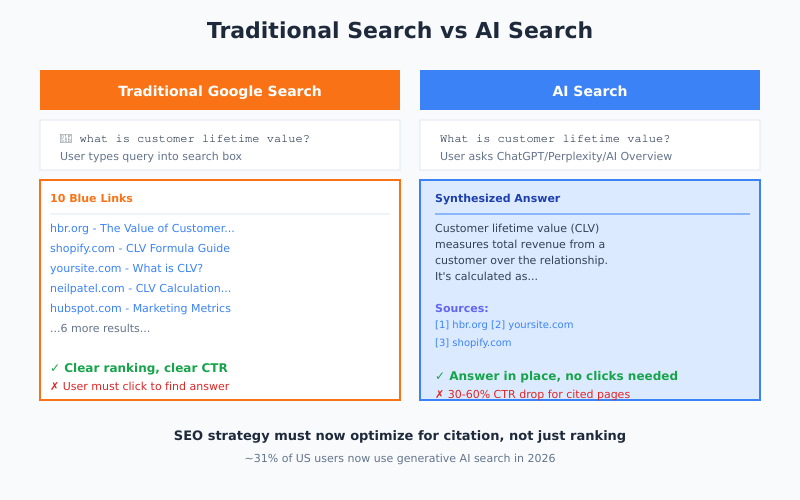
AI search is the class of search interfaces that synthesize answers from multiple sources instead of returning a ranked list of links. The main players are Google’s AI Overviews (appearing above traditional results), ChatGPT with web browsing, Perplexity, Claude’s web search, and Gemini. Each one reads the web differently but shares three common behaviors:
- Pulls content from multiple pages per query
- Synthesizes a direct answer in natural language
- Cites some (not all) sources used to generate the answer
The net effect: a user asking “what is customer lifetime value” gets a definition without visiting any website. Only the users who want depth, specifics, or to verify the AI’s claim click through. That shifts which pages get traffic and how you optimize for being the page that gets clicked.
GEO and AEO: What’s Actually Different
Two acronyms have emerged for the sub-disciplines of optimizing for AI search:
- GEO — Generative Engine Optimization: optimizing for citation in generative AI responses (ChatGPT, Claude, Perplexity)
- AEO — Answer Engine Optimization: optimizing for AI-powered search features like Google’s AI Overviews and featured snippets
However, the distinction is academic. In practice, the tactics that work for GEO also work for AEO, because both systems reward the same content traits: clear structure, authoritative sourcing, specific answers to specific questions, and data that can be extracted cleanly. Don’t overthink the acronyms. Focus on what makes content AI-citable.
What Changes for SEO
Traditional SEO optimizes for ranking — getting blue-link position. AI search SEO optimizes for inclusion in generated answers. The mechanics differ in five ways that matter:
1. Traffic Profile Changes
AI Overviews have reduced CTR on top-ranking pages by an estimated 30-60% for informational queries. For the clicks that remain, the title and description Google shows still decide who gets them — preview how your title and meta appear in Google before you publish to make sure the snippet earns the click. Traffic now skews heavily toward:
- Transactional queries (AI can’t close the purchase for you)
- Queries where users want tool comparisons or detailed specs
- Niche or long-tail queries where AI has less training data
- Queries where users explicitly want “the source” (compliance, legal, medical)
Therefore, the highest-value SEO targets are shifting away from top-of-funnel informational content toward middle and bottom-of-funnel content where intent is commercial. For broader context on how this connects to attribution, see marketing attribution and why it’s getting harder.
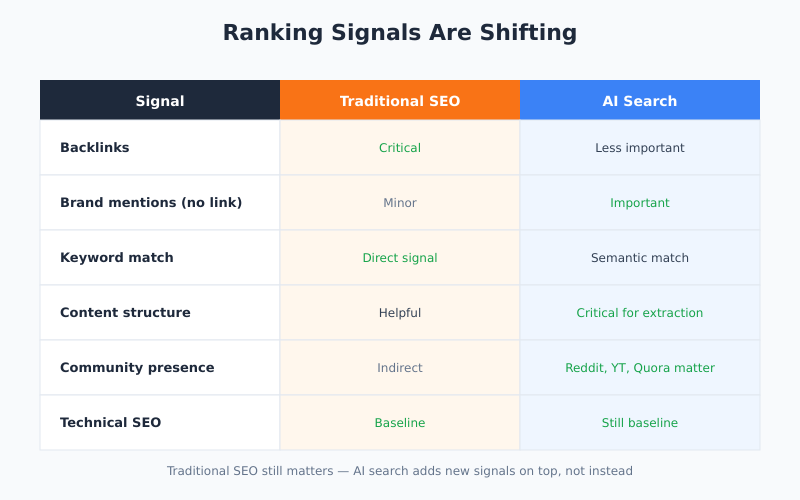
2. Ranking Signals Get Flatter
AI systems pull content from pages that may not rank in the top 10 of traditional SERPs. Being “findable and quotable” matters more than being “ranked first.” A clearly-written page at position 15 with strong answer structure can get cited over a mediocre #1.
3. Community Content Rises
LLMs pull heavily from Reddit, YouTube, Wikipedia, Stack Exchange, and Quora. If your brand appears in relevant community threads, you gain AI citation surface. Specifically, helpful Reddit comments from your team members (with proper disclosure) now count as SEO work.
4. Entity Understanding Matters More
AI models track entities (companies, people, products, concepts) and their relationships. Consistent naming, schema markup, and cross-platform presence (Wikipedia, Crunchbase, LinkedIn, industry directories) reinforce entity recognition.
5. Brand Mentions Work Without Links
LLMs learn from unlinked brand mentions during training. A mention of your product in a trusted publication now has SEO value even without a backlink. This reverses decades of link-focused optimization.
How to Optimize Content for AI Search
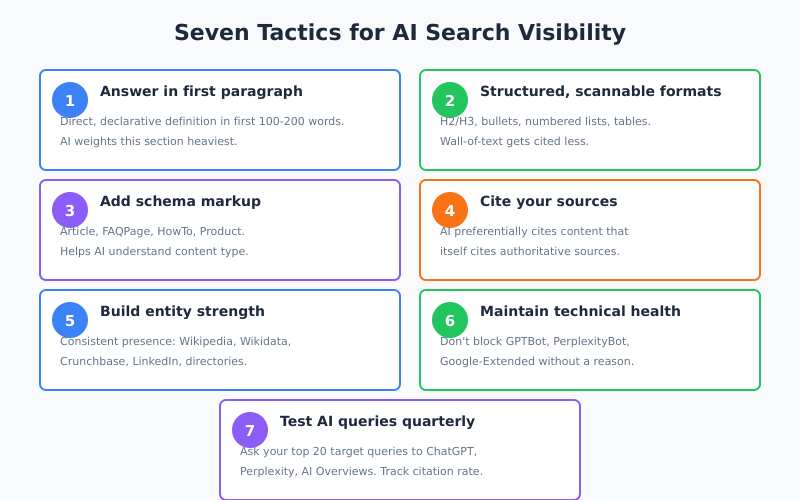
Seven tactics that have produced measurable citation lifts in my work:
1. Answer the Question in the First Paragraph
AI models heavily weight the first 100-200 words of a page. A direct, declarative answer — “A canonical URL is…” — in the opening paragraph dramatically increases citation likelihood. Burying the definition under 400 words of setup is the single most common AI-visibility mistake I see on otherwise good content.
2. Use Structured, Scannable Formats
AI systems extract content more reliably from clearly structured pages: H2/H3 hierarchy, bullet lists, numbered steps, comparison tables. Wall-of-text paragraphs get summarized worse and cited less.
3. Add Schema Markup
FAQPage, HowTo, Article, and Product schema all help AI systems understand what your content is and isn’t. The minimum baseline: Article schema with explicit author, datePublished, and dateModified. Before you ship, paste the rendered JSON-LD into a JSON-LD validator — silent typos in @type or nested entities are the most common reason “marked-up” content still gets ignored by AI engines. The Google structured data intro is a good reference for deciding what to add, and a schema markup planner helps you map which entity types belong on which page templates.
4. Cite Your Sources Transparently
AI systems preferentially cite content that itself cites sources. Adding clear external references — links to official docs, studies, and data — signals authority. Ironic but consistent across systems.
5. Build Entity Strength
Make sure your brand, products, and key people have consistent presence across Wikipedia (where eligible), Wikidata, Crunchbase, LinkedIn, Google Business Profile, and industry-specific directories. Same name, same description, same logo.
6. Maintain Technical Health
AI crawlers (GPTBot, Claude-Web, PerplexityBot, Google-Extended) need to access your site. Don’t block them in robots.txt unless you have a specific reason — and if you do want to allow some while blocking others (say, permit Perplexity but deny ByteDance), build the rules with a GPTBot blocker rather than hand-editing user-agent strings. Check Core Web Vitals and server response times — slow sites get crawled less often by AI.
7. Write for Humans, Then Check AI Queries
Quarterly, ask your top 20 target queries directly to ChatGPT, Perplexity, and AI Overviews. Check whether you’re cited. If you’re not, read the citations you’re losing to and identify gaps.
Measuring AI Search Visibility
Traditional SEO tools are still catching up. The metrics that actually matter:
| Metric | How to Measure | Good Benchmark |
|---|---|---|
| Citation rate | Manual testing of top queries across AI engines | Cited in 10-30% of relevant queries |
| AI-referred traffic | GA4 referrer filter for chatgpt.com, perplexity.ai, etc. | Growing 20-40% quarter over quarter |
| Share of voice | Profound, AthenaHQ, or similar GEO trackers | Depends on category |
| Brand mention frequency | Track mentions in Reddit, YouTube, news | Steady or growing |
| Traditional rankings | Still matters for classic SERP positioning | Top 10 for target queries |
In practice, build a spreadsheet of your 20-30 most important queries, run them against ChatGPT, Perplexity, and Google AI Overviews monthly, and record whether you were cited. It’s manual but produces data no third-party tool matches yet. For a deeper breakdown of how traffic patterns are shifting, see the Adobe SEO 2026 analysis.
What NOT to Do
Four panic-driven moves I’ve seen teams make and regret:
- Don’t abandon traditional SEO. Blue-link traffic still exists and still matters. AI search isn’t a replacement; it’s an additional layer.
- Don’t block AI crawlers by default. Some teams block GPTBot to “protect content.” Unless you have a specific business reason, you’re just making yourself uncitable.
- Don’t write for AI instead of humans. Content that reads like machine-optimized prose performs worse with both. Write clearly for humans; AI prefers clearly-written content anyway.
- Don’t spam AI systems. AI responses suppress obviously self-promotional content. Forcing brand mentions into Reddit or artificially stuffing schema rarely works and risks trust penalties.
Specifically, the temptation to “hack” AI visibility with manipulation tactics is strong and usually self-defeating. The systems are tuned against the patterns those tactics produce.
The Emerging Playbook
After tracking this for 18 months, the teams that are winning at AI search do four things consistently:
- Produce genuinely high-quality content — clear, specific, well-sourced. Quality matters more for AI than for traditional SEO.
- Build distribution beyond their own site — Reddit, YouTube, podcasts, industry publications. AI systems reward multi-surface presence.
- Maintain strong technical SEO — crawlability, schema, internal linking. AI needs to find and parse the content.
- Measure citation rate, not just traffic — because the traffic signal is delayed and fuzzy. Citation is the leading indicator.
Ultimately, AI search SEO is SEO done honestly. The shortcuts that sometimes worked against the old algorithm don’t work against LLMs. The fundamentals — clear writing, accurate information, strong sources, technical cleanliness — matter more, not less. The arc from rigid XML grammars to flexible JSON-LD entities, traced in the JSON-LD migration guide, is what made AI citation possible in the first place. For teams that always built on those fundamentals, the transition is easier than the hot takes suggest.
Bottom Line
AI search SEO means treating ChatGPT, Perplexity, and AI Overviews as new ranking surfaces alongside Google blue links. The tactics — direct answers up top, clean structure, schema markup, entity consistency, community presence — are mostly things good SEO teams already did. What’s new is the measurement discipline: you now need to track citation rate by AI engine, not just keyword rankings.
Therefore, don’t panic-restructure your SEO strategy around AI. Add AI citation measurement to your quarterly reporting, audit your content for direct-answer structure, fix schema gaps, and check whether you’re cited on your 20 most important queries. The rest is continuing to do what good SEO always required — just with a wider definition of where “ranking” happens.