What Is Customer Lifetime Value (CLV) and How to Calculate It
What Is Customer Lifetime Value?
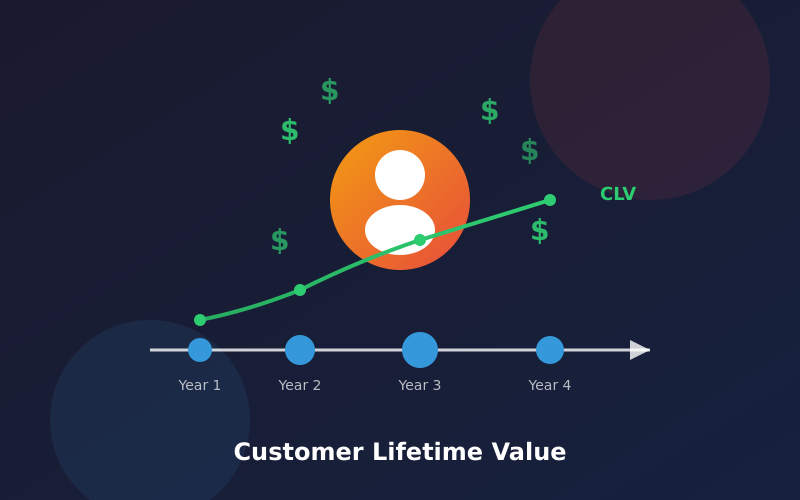
Customer lifetime value (CLV) is the total revenue you can expect from a single customer throughout your entire relationship with them. In other words, it’s the sum of all purchases a customer makes before they stop buying from you. Some people call it LTV (lifetime value) or CLTV. They all mean the same thing.
The concept is simple: instead of looking at each transaction in isolation, you zoom out and ask, “How much is this customer worth to my business over time?” As Shopify’s CLV guide explains, this shift from transactional thinking to relationship thinking fundamentally changes how you evaluate marketing spend.
However, the simplicity of this definition hides significant complexity. In fact, calculating CLV accurately requires data most businesses don’t have, and the number itself can be misleading if you don’t understand what it represents.
Why CLV Matters (And When It Doesn’t)
CLV helps you answer practical business questions. Specifically, it addresses three key concerns:
- How much can I spend to acquire a customer? If your CLV is $300, then spending $100 to acquire a customer makes sense. Spending $400 doesn’t.
- Which customers deserve more attention? Not all customers are equal. Some will buy once and disappear. Meanwhile, others will buy repeatedly for years.
- Is my business healthy? If CLV is declining, you have a retention problem. Conversely, if it’s growing, customers are sticking around longer or spending more.
That said, CLV isn’t useful for every business. For example, if you sell one-time purchases (like a wedding photographer), there’s no “lifetime” to calculate. Consequently, the metric only makes sense when you have repeat customers or subscriptions.
The Basic CLV Formula
The most common formula is:
CLV = Average Purchase Value × Purchase Frequency × Customer Lifespan
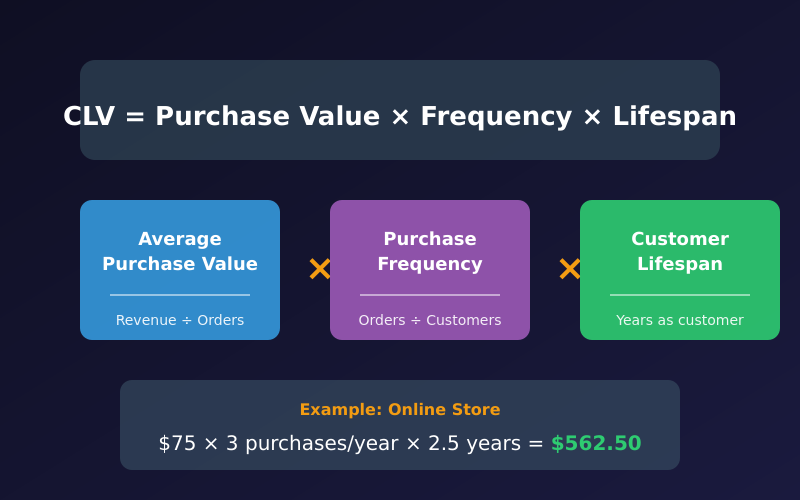
Let’s break this down into its components:
- Average Purchase Value = Total Revenue ÷ Number of Purchases
- Purchase Frequency = Number of Purchases ÷ Number of Unique Customers
- Customer Lifespan = Average number of years (or months) a customer stays active
Example: A Clothing Store
Suppose you run an online clothing store with these numbers:
- Average order value: $75
- Customers buy 3 times per year on average
- Average customer stays active for 2.5 years
CLV = $75 × 3 × 2.5 = $562.50
Therefore, you can expect to earn about $562 from each customer over their lifetime with your store.
The SaaS/Subscription Formula
If you run a subscription business, the formula is different. Since customers pay monthly and can cancel anytime, you use churn rate instead of purchase frequency. This is similar to how bounce rate measures user departures in analytics — churn measures customer departures over time.
CLV = (Monthly Revenue per Customer × Gross Margin) ÷ Monthly Churn Rate
Alternatively, you can use the simpler version:
CLV = Average Monthly Revenue ÷ Monthly Churn Rate
Example: A SaaS Product
Suppose you have a software product with these metrics:
- Average monthly revenue per customer: $50
- Monthly churn rate: 2.5%
CLV = $50 ÷ 0.025 = $2,000
Additionally, this calculation also tells you the average customer lifespan: 1 ÷ 0.025 = 40 months (about 3.3 years).
The CLV to CAC Ratio: The Number That Actually Matters
CLV alone doesn’t tell you much. For instance, a $2,000 CLV sounds great until you learn you’re spending $3,000 to acquire each customer.
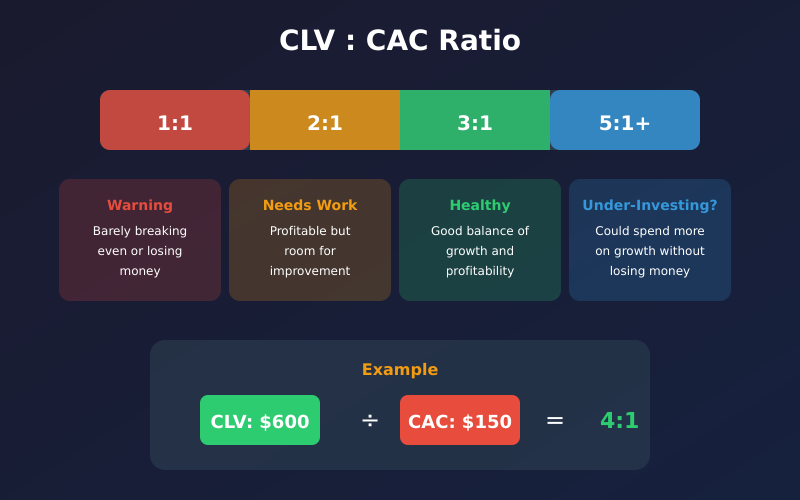
This is why the CLV:CAC (Customer Acquisition Cost) ratio is more useful than CLV alone.
CLV:CAC Ratio = Customer Lifetime Value ÷ Customer Acquisition Cost
What the Ratio Means
- 3:1 or higher — Generally healthy. In essence, you earn $3 for every $1 spent on acquisition.
- 5:1 or higher — Could mean you’re under-investing in growth. As a result, you might be leaving money on the table by not acquiring more customers.
- 1:1 or 2:1 — Warning sign. Basically, you’re barely breaking even on customer acquisition, or you’re losing money.
- Below 1:1 — You’re paying more to get customers than they’re worth. Clearly, this is unsustainable.
Moreover, this ratio helps you make practical decisions. If your ratio is 4:1 and you want to grow faster, you can afford to increase acquisition spending. On the other hand, if it’s 1.5:1, you need to either reduce acquisition costs or improve retention. Understanding which acquisition channels bring the highest-CLV customers requires solid marketing attribution — without it, you can’t calculate accurate per-channel CAC.
The Hard Truth About Calculating CLV
Here’s what most CLV guides don’t tell you: calculating accurate CLV is surprisingly difficult. Below are the main challenges.
The Customer Lifespan Problem
How do you know how long customers stay? For active customers, you’re guessing. Indeed, a customer who bought last month might buy again for 10 years or never return. You won’t know until they’re gone.
Most businesses use historical averages: they look at customers who have stopped buying and calculate how long they stayed. However, this approach has problems too. Market conditions change. Your product changes. As a result, past behavior may not predict future behavior.
The Cohort Problem
Customers acquired in different ways behave differently. For example, customers from Google Ads might have different CLV than customers from referrals. Similarly, customers who joined during a sale might churn faster than full-price customers.
A single CLV number hides these differences. Therefore, sophisticated businesses calculate CLV by cohort (acquisition channel, time period, customer segment) rather than using one number for everyone.
The Profit vs. Revenue Problem
The basic formula calculates revenue, not profit. To illustrate: if your margins are thin, a $500 CLV might mean only $50 in actual profit. Some businesses use gross margin in the formula; others don’t. Consequently, make sure you know which version you’re calculating.
Historical vs. Predictive CLV
There are two main approaches to CLV:
Historical CLV
First, there’s historical CLV. You add up all the revenue from a customer (or average customer) over their actual relationship with you. This method is accurate for past customers but doesn’t help predict future behavior.
Best for: Understanding what happened, evaluating marketing campaigns after the fact.
Predictive CLV
Second, there’s predictive CLV. You use statistical models to forecast future customer behavior based on past patterns. This approach is useful for planning but inherently uncertain.
Best for: Setting acquisition budgets, identifying high-potential customers early.
In addition, most small businesses should start with historical CLV. Predictive models require more data and statistical expertise to build correctly.
CLV Benchmarks: Why Comparisons Are Misleading
You might wonder: “What’s a good CLV?” The honest answer: it depends entirely on your business.
Here are some rough industry figures to illustrate how wildly CLV varies:
- E-commerce (clothing, beauty): $150-$500
- SaaS (B2B software): $5,000-$50,000+
- Telecommunications: $2,000-$5,000
- Professional services: $10,000-$1,000,000+
- Coffee shops: $1,000-$15,000 (for loyal daily customers)
Comparing your CLV to another industry is meaningless. Instead, comparing to your own CLV last year is much more useful. Is it going up or down? That trend matters more than the absolute number. This is similar to how conversion rate benchmarks vary so widely that cross-industry comparisons often mislead more than they help.
How to Improve CLV
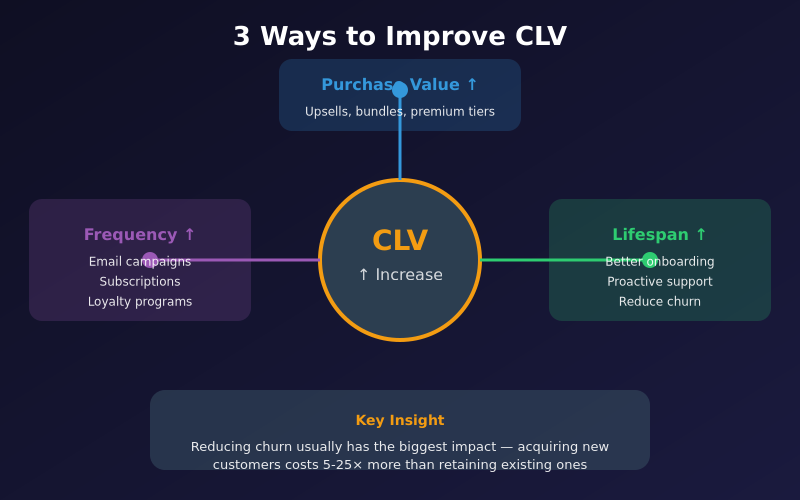
There are only three levers to improve CLV. Essentially, you can work on any of these:
1. Increase Average Purchase Value
- Upselling and cross-selling
- Bundling products together
- Premium tiers or add-ons
- Raising prices (if the market allows)
2. Increase Purchase Frequency
- Email reminders and re-engagement campaigns
- Subscription or auto-replenishment options
- Loyalty programs that reward repeat purchases
- New product launches that give reasons to return
3. Extend Customer Lifespan
- Better onboarding to help customers succeed
- Proactive customer support
- Regular product improvements
- Building switching costs (integrations, data, habits)
For most businesses, reducing churn (extending lifespan) has the biggest impact. According to research published by Harvard Business Review, acquiring a new customer costs 5-25x more than retaining an existing one. Therefore, retention often delivers better ROI than acquisition.
When CLV Is Overkill
Not every business needs to obsess over CLV. Here’s when you can skip the complicated calculations:
- You’re just starting out — You don’t have enough data for meaningful calculations. Instead, focus on getting customers first.
- You sell one-time purchases — Wedding services, home buying, etc. There’s no repeat business to measure.
- Your business is simple — If you have one product at one price with stable retention, the math is obvious. In that case, you don’t need a spreadsheet.
On the other hand, CLV becomes essential when you’re making significant acquisition investments. If you’re spending serious money on ads, you need to know your CLV to avoid burning cash. This is especially true for businesses focused on SEO and organic growth, where acquisition costs can be harder to track.
A Practical Starting Point
If you’ve never calculated CLV before, here’s a simple approach to get started:
- Pick a time period — Look at customers from 2-3 years ago (old enough that many have churned)
- Calculate total revenue — Add up everything those customers spent
- Divide by customer count — This gives you historical CLV for that cohort
- Compare to acquisition cost — What did you spend to get those customers?
This won’t be perfect, but it will give you a baseline. From there, you can refine your calculations over time. For a more detailed walkthrough of CLV calculation methods, Neil Patel’s guide to calculating lifetime value covers additional approaches.
The Bottom Line
Customer lifetime value is a powerful concept, but the number itself is less important than what you do with it. Ultimately, a rough CLV estimate that guides better decisions is more valuable than a precise calculation that sits in a spreadsheet.
Focus on the CLV:CAC ratio rather than CLV alone. Track trends over time rather than obsessing over absolute numbers. And remember: the goal isn’t to calculate CLV perfectly. Instead, the goal is to build a business where customers stick around and keep buying.
That’s something no formula can do for you.