
Cookieless analytics is no longer a fringe compliance tactic — it’s becoming the default for privacy-conscious teams and the only legal option in a growing number of jurisdictions. The question isn’t whether to consider it anymore, but how it actually works and whether it gives you enough data to run marketing decisions on. I’ve migrated several sites off Google Analytics to cookieless alternatives, and the reality is more nuanced than either camp wants to admit. The shift mirrors a broader move across web measurement — from heavy, brittle, identifier-based plumbing toward lightweight, declarative formats — covered in detail in this JSON-LD migration guide.
In this guide, I’ll explain how cookieless tracking works technically, when it’s legally required, what you gain and lose compared to traditional analytics, and how to pick an implementation that matches your compliance risk and data needs.
What Is Cookieless Analytics?
Cookieless analytics is any method of tracking website activity that doesn’t rely on third-party or persistent first-party cookies to identify users. Instead, these tools use short-lived identifiers, server-side hashing, or purely aggregate data to count visits, pageviews, and events — without creating a long-term profile of any individual visitor.
The motivation is legal as much as technical. Under GDPR, ePrivacy, and similar frameworks, any cookie that tracks behavior beyond what’s strictly necessary for the site to function requires explicit user consent. Cookieless analytics avoids that requirement entirely, or reduces it to a short, purpose-limited notice — which is why tools like Plausible, Fathom, and Simple Analytics have grown so fast in the EU market.
Why Cookieless Matters in 2026
Three converging pressures made cookieless a mainstream question:
- Regulatory tightening. EU data protection authorities — France’s CNIL, Austria’s DSB, Italy’s Garante — have issued rulings finding standard Google Analytics 4 implementations unlawful. Fines range from €10K to €1M per violation.
- Browser-level cookie restrictions. Safari’s ITP, Firefox’s ETP, and the pending (and continuously delayed) Chrome third-party cookie phase-out mean cookie-based tracking is becoming technically unreliable regardless of legality.
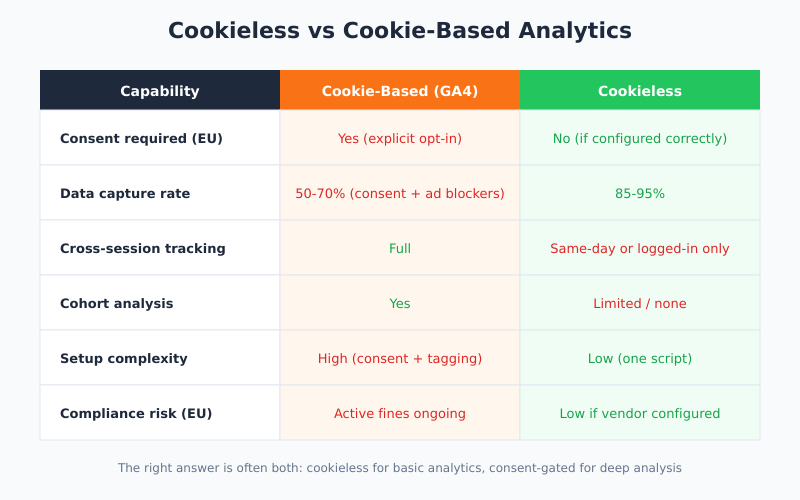
- User behavior. Ad blockers now reach 30-50% of technical audiences. Cookie banner fatigue means consent rates on standard implementations hover around 50-70% for EU traffic — meaning half your data is gone before you even analyze it.
Specifically, if your site operates in the EU or UK, standard GA4 without substantial hardening is a compliance risk your legal team probably hasn’t caught up to yet. For broader context on why marketing measurement keeps getting harder, see marketing attribution and why it’s getting harder.
How Cookieless Tracking Works
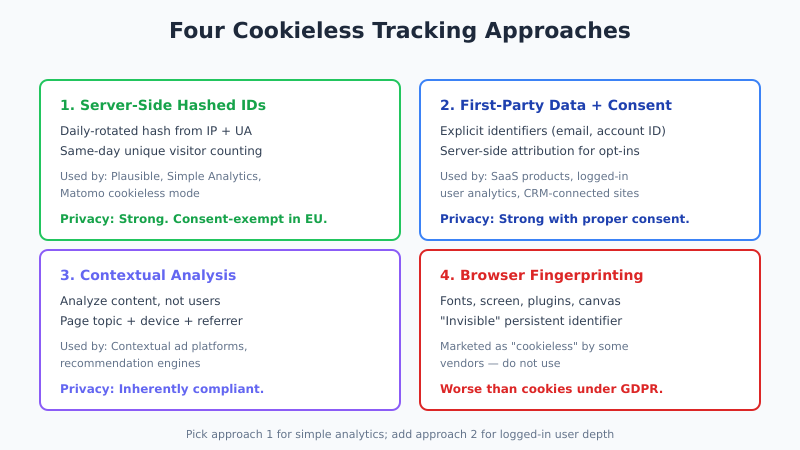
There’s no single “cookieless” technique — it’s a family of approaches that trade different things for different privacy guarantees. The four most common:
1. Server-Side Hashed Identifiers
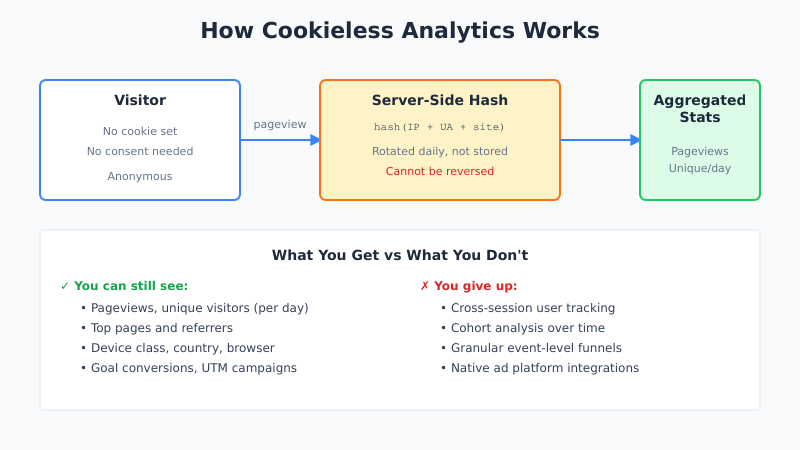
The most popular approach in privacy-first tools. Instead of storing a persistent cookie, the server computes a short-lived hash from the user’s IP, user agent, and site URL. The hash rotates daily and isn’t stored beyond aggregation. Plausible, Simple Analytics, and Matomo’s cookieless mode all work this way.
Because the hash changes daily, these tools can’t follow a user across sessions — they count unique visitors per day, not cross-day cohorts. That’s a significant data limitation but a strong privacy guarantee.
2. First-Party Data with Consent
You explicitly collect identifiers (email, account ID) from users who opt in, then use those for server-side attribution. This gives you full tracking for logged-in users and aggregate-only data for everyone else. It’s what most SaaS companies do by default.
3. Contextual Analysis
Instead of identifying users, analyze content. Page content, referrer, time of day, and device class produce a “context” that can inform content and ad decisions without touching user identity. This is how contextual advertising has re-emerged.
4. Fingerprinting Alternatives (Avoid)
Some tools advertise “cookieless tracking” via browser fingerprinting — collecting enough signals (fonts, screen size, plugins) to identify returning users. Legally, this is worse than cookies in most EU interpretations, since users have no way to consent or delete the fingerprint. Don’t use these tools if compliance matters.
What You Lose Going Cookieless
Honest trade-offs. Switching to cookieless analytics gives up real capabilities. In my experience running both side-by-side:
| Capability | Cookie-based (GA4) | Cookieless (Plausible/Fathom/Matomo) |
|---|---|---|
| Cross-session user tracking | Full (via client ID) | Limited to same-day or logged-in users |
| Attribution model flexibility | Multiple models, data-driven default | Last-click or first-click only |
| Cohort analysis | Yes | Generally no (privacy-by-design) |
| Granular funnel analysis | Full event-level detail | Aggregate-level only |
| Ad platform integrations | Native Google Ads, Meta, LinkedIn | Manual via UTM parameters and CSV exports |
| Custom event tracking | Deep customization | Basic event support in most tools |
However, these losses are less painful than they sound. Most teams use 10% of GA4’s capabilities and make 90% of their decisions from the simple metrics cookieless tools deliver well — pageviews, sources, top pages, goal conversions. For detailed funnel work, you may need to supplement with a product analytics tool like PostHog or Mixpanel running on first-party consent.
Legal Position by Jurisdiction
The EU is the primary driver, but the rules vary. Simplified summary:
- France (CNIL): Has explicitly exempted cookieless analytics from consent requirements when configured correctly. Standard GA4 is not exempt.
- Germany (DSK): Similar position — cookieless analytics generally permitted without consent; GA4 requires consent and has faced fines.
- Italy (Garante): Has fined sites using GA4 without supplementary measures; cookieless tools generally compliant.
- UK (ICO): Cookie-based analytics requires consent under PECR; cookieless is exempt.
- US (CCPA/CPRA): Allows sale-of-data opt-out, but doesn’t require cookie consent. Both approaches legal with proper privacy notices.
- California (CPRA): Similar to federal; state-specific opt-out rights apply.
Specifically, if you operate across these jurisdictions, the path of least friction is usually: cookieless for basic analytics, consent-based cookies for anything deeper (ad platforms, heatmaps, session recordings). This aligns with how A/B testing tools typically need consent even when your analytics doesn’t.
Choosing a Cookieless Analytics Tool
The top privacy-first tools in 2026, with honest trade-offs:
| Tool | Strengths | Limitations | Best For |
|---|---|---|---|
| Plausible | Simple, clean UI, fast, EU-hosted | Limited customization, basic events | Content sites, blogs, SaaS landing pages |
| Fathom | Privacy-hardened, good dashboard | Similar scope to Plausible | Privacy-sensitive consumer sites |
| Matomo (cookieless mode) | Full-featured, self-hostable, GDPR-ready | Setup complexity; may need tuning | Teams wanting GA-like depth on EU terms |
| Simple Analytics | Minimal, no cookies, easy setup | Smallest feature set | Personal sites, marketing landing pages |
| Umami | Open-source, self-hosted, low-cost | Self-host operational burden | Developer-heavy teams with ops capability |
In practice, I recommend running a cookieless tool alongside any consent-gated GA4 for the first quarter after migration. Compare the numbers. You’ll find cookieless counts 10-30% higher on EU traffic because it isn’t filtered by consent refusal.
Implementation Checklist
If you’re migrating to cookieless analytics, the order of operations matters. Skipping steps creates compliance gaps that are hard to audit later.
- Audit current cookies. Use a browser extension like EditThisCookie or a tool like Cookiebot’s scanner. Document every cookie set by your site and its purpose.
- Identify which data you actually use. Pull your top 20 reports from the last year. If no one looks at user-level retention cohorts, you don’t need cookie-based tracking for them.
- Pick a primary cookieless tool based on the table above. Install in parallel with GA4 for validation.
- Run both for 30-90 days. Compare traffic counts, top pages, and referrer data. Expect cookieless to report 10-30% more traffic on EU segments.
- Reduce GA4 scope to only what cookieless can’t do — typically logged-in user cohorts and deep event analysis. Behind consent.
- Update privacy policy and cookie banner. Remove references to cookies that no longer fire. This is where legal review catches things engineers miss.
- Monitor quarterly. Cookieless tools evolve; so do regulations. Review configuration at least every quarter.
For context on how this connects to broader tracking reliability, see the related analysis of bounce rate metrics, which often shift noticeably between cookie-based and cookieless implementations because engagement definitions differ. The Plausible data policy is also a good concrete example of what compliant cookieless architecture looks like in practice.
Bottom Line
Cookieless analytics is no longer a compliance workaround — it’s a legitimate architecture choice that solves real problems with cookie consent friction, ad blocker loss, and regulatory risk. For most content-driven sites, you give up less than you’d expect and gain measurably cleaner compliance posture and more complete data capture in the EU.
Therefore, if you’re spending legal hours on GA4 consent banners, getting sub-70% consent rates, or facing any compliance review in the EU, a cookieless migration probably costs less than maintaining the status quo. Start with parallel installation, compare the numbers for a quarter, and decide based on real data rather than marketing claims from either side.